A meeting of the minds – mappers, videographers, editorial board & SMS reporters

by: jamie September 8th, 2010 comments: 0

The Map Kibera family is continually growing. The groups and activities – Mapping, Voice of Kibera, Kibera News Network – we are involved with multiply and evolve in exciting and unexpected ways. Each group has its own history and set of current activities. Everyone involved has a unique talents, skills and interests, which contribute to the success of the Map Kibera programme.

These projects come together intuitively and almost seamlessly online. One challenge that arises however is that the groups and individuals do not necessarily collaborate offline (very often).

On August 30th, 2010 the Map Kibera family (about 40 people in total) came together for the first time at the NaiLab. The main objective of the day was for everyone to get to know each other and the work that they’ve been doing. A second objective was to explore how we could collaborate and work more closely offline. Most importantly we wanted to recognize the achievements and challenges of each group so far and identify goals for the future.

The Map Kibera family!

The Map Kibera family!

A summary of the achievements of all 3 groups

  • Networking and meeting new people in Kibera, Kenya and around the world
  • Recognition of our work within the community and globally
  • Leading the way in terms of information sharing in Kenya
  • Positive learning experiences within the group(s)
  • Learning more about the people and geography of Kibera
  • Gaining new skills (e.g. computer skills, camera handling, video editing, GIS including OpenStreetMap, etc.)

And the challenges

  • Hostility and suspicion from some community members which sometimes leads to demands for payment in exchange for information
  • Difficulty in raising awareness about the different websites within the community
  • Limited financial resources result in the need to balance volunteering for the group with the need to make a living
  • Lack of professional skills
  • Technical glitches related to the different web-based software we use
  • Lack of equipment and other resources

Group and personal goals:

  • To work together to make one strong team
  • To share information and helping the community in Kibera
  • To create jobs and train others
  • To become a better public speaker
  • To gain personal, professional skills
  • To improve technical skills
  • To become professional media group(s) handling 1st hand information from Kibera

We are committed to adding to the list of achievements, addressing the challenges and, over time, meeting the personal and group goals. Everyone is looking forward to the collaboration and work online and (more importantly) offline!

A special thanks to Rose Nyawira who joined us from Community Clean Services (CCS) – we look forward to working with her again in the near future!

Rose facilitating a team building exercise

Rose facilitating a team building exercise

Kibera’s Census: Population, Politics, Precision

by: mikel September 5th, 2010 comments: 0

The 2009 Kenyan census puts Kibera’s population at 170,070, very far from the usual 1 million plus figure thrown around. The scale of the change has rightly shocked people.

When we first prepared to come to Kibera last year, we looked for a source for this one million number. It was widely quoted in all the major media and even the UN, but never with a source, and we found this very suspicious. With caution, we always qualified the population number in writing and presentations with a question mark or the clause “widely quoted number”. With a little more investigation, we found some quality work on this question. The Map Kibera Project (different project, similar in spirit, unintentional namespace clash) undertook a door to door survey in Kianda village, and based on the population density there, extrapolated to all of Kibera for a figure of 235000-270000. The KeyObs RESPOND project derived an estimate of the number of built structures in Kibera from satellite imagery, and then conducted a sample to estimate population per structure, and came up with a number in the range from 199,959 to 205,108. Both efforts clearly published their methodology and seemed like reasonable efforts.

Despite this, when Jill Biden visited Kibera in June, the White House reported the number jumping to 1.5 million! What motivations are there inflating Kibera’s population numbers? The cynical claim is that NGOs and CBOs use the 1 million number to benefit themselves. I don’t see much evidence that people are getting rich from NGOs, but then there’s not much evidence at all of how much money has flowed through Kibera ineffectively. Certainly Kibera has had more attention than other places equally deserving of help, and of course it is the place we started in Kenya. Kenyan’s understandably want to change the perception of informal areas. The large number of retweets I think reflects the desire of well-off Kenyans to put Kibera behind them. Despite the 1 million number falling, Kibera is still a place underserved by government, and one of many informal settlements in Nairobi and other parts of Kenya. The truth is that Kibera is still there.

In our work, somehow Kibera never felt like “1 million”, and but much closer to the MKP and KeyObs number. We had been talking about replicating the KeyObs work with satellite imagery, and also counting daily out and in flux as Kiberians going to work in the industrial area and surrounding estates.

We’re glad to see that light has finally fallen on Kibera’s population in a big way. Certainly a revision is needed. But we’re concerned with the way these new numbers from the Kenyan Census are seized on without question. The number 170,000 is at least on the same scale as previous counts, but it is relatively lower. There are no doubt issues with doing any sort of census anywhere, but especially in a place like Kibera. Definitely the Kenyan census was undertaken professionally, but part of that professional work would be openly discussing methodology and difficulties encountered. Collecting data in an informal settlement is challenging … what special measures were taken by the Kenyan census in Kibera?

The truth is that we still don’t know how many people live in Kibera. It’s a different number today than yesterday. The definition of “living” in Kibera varies, it’s quite a transient place. Whether it’s 170000 or 1.5 million, the truth of that number is intertwined with the understanding of where it’s coming from. And questioning authority in Kenya doesn’t come easy. One chink in the armor is exploited to cast doubt on the entire enterprise. Authority means knowing all.

We’ve come to Kibera fully admitting we don’t know everything. Not only is OpenStreetMap always wrong, every map is always wrong, a representation of a reality which always changes. When we think about how the map and technology will be used in Kibera, we fully admit we don’t have answers but are ready to engage with everyone to perhaps discuss the questions. Understanding that precision and authority is relative, that we don’t understand everything, and understanding the motivations and methodology of how data is collected … all is vitally important in open data, in addition to the “precise” number or position.

… and only now noticing Brian Ekdale’s excellent analysis.

Twitter Weekly Updates for 2010-09-05

by: admin September 5th, 2010 comments: 0

Powered by Twitter Tools

Twitter Weekly Updates for 2010-08-29

by: admin August 29th, 2010 comments: 0

  • RT @eugenialeee: My thoughts on crucial differences between the Mathare & Kibera slums http://bit.ly/d9OTqr #
  • New Video by KNN: Biogas Center in Kibera Investigated http://dlvr.it/4BGfR #
  • our final community meeting for Map Kibera. it's water and sanitation at KWAHO, with many professionals #
  • New Video by KNN: Rose's Orphanage in Kibera http://dlvr.it/4HrRV #
  • New Video by KNN: Talent Show in Kibera http://dlvr.it/4J1tQ #
  • Map Kibera, KNN, and Voice of Kibera at Maker Faire Africa http://is.gd/eIkJz #
  • interesting thoughts ruminating on logistics of handling a lovely donation of new cameras for KNN #
  • developed world electronics make big assumptions about secure environments for recharging, availability of specialized batteries #
  • RT @jlundine: With the kibera news network @markhamnolan @ricaji & prof robert chambers abt to kick off filming on urban disaster issues #

Powered by Twitter Tools

Ex-aug-hausting, in a good way

by: mikel August 29th, 2010 comments: 1

August has been awesome. Busy and intense, in a transitional sort of way. We’ve been putting a wrap on mapping in Kibera (for now) and planning the first replication to Mathare. And along the way, getting out, doing stuff, meeting people. Here’s a shotgun of August.

Getting Out

TedX

Regynnah has been speaking on Map Kibera, and Sande on Voice of Kibera, and TedX tours four informal settlements throughout Nairobi. It’s a great idea to make connections between these areas, they have more in common than not, and can learn and build with each other.

Maker Faire Africa

IMG_2323

Kibera News Network came out in force to contribute to the fun house that is Maker Faire Africa. Gratifying to see lots of existing knowledge and interest in Map Kibera and OpenStreetMap.

Mukuru

Primoz helped Millicent and Kevin lead a 2 day mapping party (plus 2 day follow up) with mappers in Mukuru. These guys have been working with Partnership for an HIV-free Generation and Emory University, and had previously done some paper based mapping. Super enthusiastic group, opens the door to more work there.

Getting Recognized

Youth Fund

Map Kibera was awarded a grant by the UN Habitat Youth Fund! The group now has support to directly and independently replicate in another Nairobi informal settlement, sometime next year. We’ll have more to say on this later on.

Ars Electronica

And we were awarded Distinction by the Ars Electronica Festival, in Digital Communities category! Should be even more wild than Maker Faire.

Robert Chambers and Mark Hamnolan

Kibera News Network has been going strong, producing high quality reporting, during the Referendum and otherwise. This weekend, they had a visit from Professor Robert Chambers, a pioneer in participatory approaches to development. And Mark Hamnolan is here, working with KNN to interview Kiberians about crisis for a Red Cross project, and generally share some skills.

Wrapping Up

Water/Sanitation is wrap

Soweto beautyfire self-help group

We finally finished editing on the final theme of “phase 2″ of Map Kibera, Water and Sanitation. We held a community map drawing meeting at the offices of KWAHO, attended by many professionals from the watsan network of Kibera. The discussion was extremely interesting, and opened up many possibilities for application of maps and other tools for their work.

We’ll continue to engage in Kibera, to figure out how the map can live and benefit this and other core issues.

Put a bow on it

With help from Meghana, we’re redesigning the Map Kibera site to present everything we’ve learned over the past 6 months. Luckily we’re in good hands.

On the mapping side itself, Eric Brelsford has been rationalizing the crazy tags that evolved out of mapping the kind of place completely new to OpenStreetMap. He’s looking at improving the rendering for each theme, in seperate layers, and may be getting some help from a certain large company that’s recently taken a big interest in OSM.

On the printing side, we’re nearly through the design process for the posters and atlas. Primoz and Emma have been working hard translating the mass of digital information to paper. These will be printed up in the hundreds and distributed to organizations, schools, etc throughout Kibera.

Apps4Africa

I’m mentoring two projects in Apps4Africa. I’ll have more to say on those soon.

Making Plans

Mathare, Rebel Film Board, PLAN CLTS

In Mathare, we’ve been greeted with lots of enthusiasm when presenting to the Rebel Film Board, and the Community Total Led Sanitation network. There’s many more groups and people who are welcoming us to Mathare. The ground work is being set for our next steps there. PLAN International is also coming on board to support.

Strategic Thinking

In the rest of our free time, we’ve been taking a look to the long term. How do we carefully build on the successes in Kibera, and bring the benefit of these tools to new communities? Will be interesting for sure.

Mapping Flood Damage in Kibera

by: primoz August 28th, 2010 comments: 0

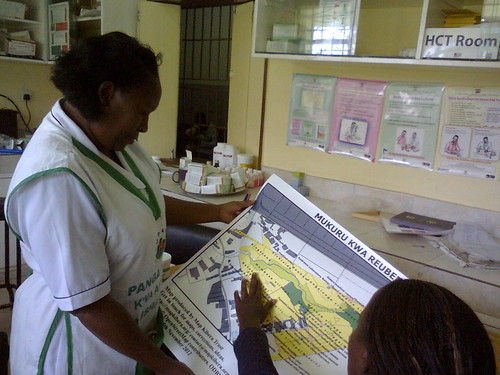
A couple of months ago, a series of storms caused havoc in Kibera. Our team was taking a much needed vacation at the Kenyan coast, and while we were sipping gin and tonic and absorbing the sun and endless blue sky, the people of Kibera were battling against rather less favorable weather up on the high plain of Nairobi. As our team returned to Nairobi, we received a call from the United Nations OCHA Kenya: “We heard there was some flooding in Kibera and Mathare, and since you have a presence there, we’d like you to go and check it out.” We had no idea. So I called one of our mappers, Hasan, and he confirmed the whole thing.

The area where Kibera is located is very hilly. It’s made up of a group of drainage areas intersected by 5 streams, which eventually end up in Nairobi dam. During heavy rains the runoff water travels over the surface of the slum and ends up in the streams. These become overflowing, raging currents, grinding everything in their way, washing away houses, paths, garbage and people.

Hasan and I went to check out the damage and collect information. I was overwhelmed. This was a major incident which should trigger massive coverage, but went almost unnoticed, even by us. There were more than 50 houses severely damaged, displacing the inhabitants. One school was completely swept away. Walking calmly, I didn’t even notice anything in particular, until Hasan suddenly pointed out that I was standing where only days ago a school had been. Not even the foundations were visible anymore.

Damaged objects down the stream

We started collecting data points of all the damaged objects, which were mostly located on the banks of the slum’s streams. In a testimony to Kibera’s obstinate spirit, many of the damaged objects were already being repaired and rebuilt. The paths inside the slum, too, were being fixed by groups of young volunteers. People organized themselves without waiting for any kind of help or intervention from the outside. Had it not been for Hasan pointing out the repair activity among the usual busy scene of Kibera, I may not even have noticed this almost organic reaction of the slum to its wounds.

We decided that we’re not going to take the position of every damaged and rebuilt object across the slum, because it would take too much time, and we had a tight deadline. We focused on the primary damage along the streams, since we could still upgrade the information if needed, depending on the feedback. In order to collect the information as fast as possible, Hasan organized his friends around Kibera to go and look around their communities and try to figure out the extent of the damage inflicted by nature’s fury. Within two days we had an in-depth map of the extent of the damage for OCHA.

This project showed me couple of things:

-The importance of having local people on the ground, trained in data collection, which can be activated at any time. Because of this, the time in which information was available to OCHA was shortened to only a couple of days.

-The information on repaired objects could be used to make a case for compensations.

-Visibility matters: Even major events with many deaths and widespread destruction can go mostly unnoticed by the outside world when they affect marginalized places like Kibera. Recording information on damage, be it on a map or through local newscasts and papers, is the crucial first step to mobilize help in support of the local community.

Twitter Weekly Updates for 2010-08-22

by: admin August 22nd, 2010 comments: 0

Powered by Twitter Tools

Twitter Weekly Updates for 2010-08-15

by: admin August 15th, 2010 comments: 0

Powered by Twitter Tools

Reviewing the Referendum Reports

by: jamie August 12th, 2010 comments: 0

Wednesday August 4th, as Kenyans cast their votes on the proposed draft constitution the Voice of Kibera community was reporting on their experiences in Kibera.  12 SMS reporters and 10 video journalists were on the ground from the break of dawn until after the votes were tallied to tell the world what was happening in their community.

On August 4th, Voice of Kibera received 35 individual SMS reports and published 8 videos on the Kibera News Network YouTube channel.

Here are some highlights:

SMS @ 6:49 am: Mobilisation started as early as 4am with youths waking up people by blowing vuvuzela here in kianda

SMS @ 8:03 am: At kibera primary skul, thea is good organisation. Pple r being asistd incase of a problem by the local youth.

SMS @ 10:18 am: Finaly,prime minister is here at old kibera p.s to cast his historic vote.

SMS @ 2:33pm: red or green,we are all black,lets maintain peace.youth 4 peace,kibera mashimoni.

The SMS reporters team met to debrief about the experience and discuss any challenges they encountered and successes to build upon for next time. Of the 11 reporters, 3 were not able to send any SMS messages on voting day. This was not due to instability or challenges but to the professionalism of the Interim Independent Electoral Commission (IIEC). All three reporters were serving as poll clerks at polling stations around Lang’ata constituency. Unlike 2007, when voting way coordinated by the now disbanded Electoral Commission of Kenya (ECK), the IIEC took all appropriate measures to reduce the possibility of corruption. The mobile phones of all polling clerks were confiscated for the duration of the vote and they were warned against communicating information about the vote until the final official tallies were released.

Three of our other SMS reporters acted as official poll monitors who spent the day observing the activities at the polls. They too were impressed with the conduct of the IIEC and commended them on their leadership and coordination. One energetic poll monitor stayed from morning until the last vote was counted late in the evening. He was happy to report he was involved in negotiations over the validity of spoiled votes.

One major challenge echoed by all of our six official poll monitors and clerks was civic education. In the Lang’ata polling stations our group reported that between 3 and 10 percent of total ballots cast were spoiled. Many people used marks that weren’t the official check, x or dash that was required by the IIEC. A popular mark was a signature, which resulted in a spoiled vote. There was a call for continued civic education, especially with 2012 around the corner.

Kibera News Network highlighted the Referendum day events in Kibera, including celebrations the night before the historic vote. To watch more, check out the videos below.

Twitter Weekly Updates for 2010-08-08

by: admin August 8th, 2010 comments: 0

Powered by Twitter Tools

Where Am I?

You are currently browsing the Uncategorized category at Map Kibera.