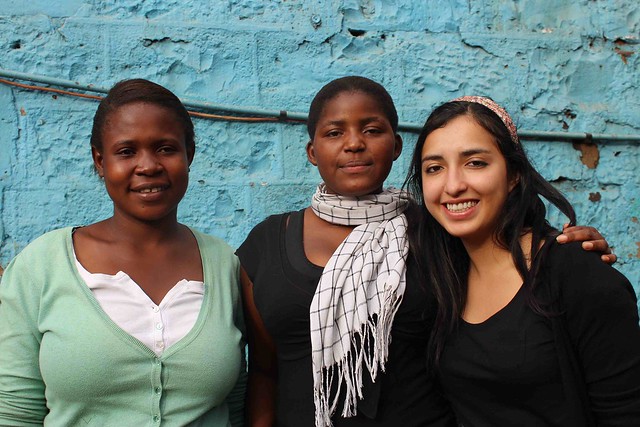
Andrea Arzaba with Yvonne Tiany in Mathare
As mentioned in a previous post, we were privileged to have guests from Global Voices visiting the Kibera and Mathare programs on July 1. The intention wasn’t only to share Map Kibera with them, but to work together on some interesting local stories for Rising Voices and our own media sites.
Rising Voices is a great initiative by Global Voices to “extend the benefits and reach of citizen media by connecting online media activists around the world and supporting their best ideas.” The authors of the posts below are part of this project and come from all corners of the globe, where they blog about important local issues. For many of them, the opportunity to travel to the Global Voices Summit is a rare chance to see this part of the world and learn about how Kenyans are practicing citizen journalism like themselves.
Five fantastic posts have so far been written by our visitors, who explored topics in Mathare and Kibera that were of interest to them. One great summary post written by the director of Rising Voices, Eddie Avila, sums up the experience.
Here are some great Flickr photo sets from our visitors, too:
Kibera photos by Laura Schneider.
Mathare photos by Andrea Arzaba.
Winning post by Steve Banner, of Kibera News Network, for the Global Voices Summit 2012 blogging scholarship competition:
After so much bloodshed in last general elections, The government of Kenya is doing everything to avoid the repeat of what happened in 2007.
In informal settlements and slums such as Kibera, where the post Election Violence was at its peak, the rise of Citizen journalism has helped in information gathering and sharing. hence becoming a vital tool to spread the message of peace among the youths, who are mostly the target by politicians in carrying out negative vices and violence in the community.
In Kibera, we have seen the rise of citizen journalism, who collect information in their communities in form of reports, news and also documentaries. one such group is the Kibera News Network, which comprises of youths born and brought up in Kibera slums hence they understand the community well, better than the mainstream media who just focus on the negative side of the community.
KNN collect stories in Kibera then organise for community screenings within Kibera where members of the community get information on what take place in different villages, through this screenings come forums where community members share opinions on how to create a peaceful society and discuss different projects going on within Kibera and how they can get to benefit from this projects. this help bring about togetherness hence creating harmony within the community.
Citizen media can also get to monitor elections from the grassroots since they are community based, hence helping to bridge the gap of misinformation which may have contributed to last post election violence.
They also organise Peace walks within Kibera which help bring together the community and the aspiring political candidates who give speeches preaching peace and togetherness among the community members.
However, there is still a lot to be learnt by citizen journalists, given that most of them may be green in journalism field and may need a lot of training in handling the heat that comes with election monitoring and also getting the necessary support in organising peace forums within the community and engaging them in civic education.
Citizen media has overcome many obstacles and achieved a lot. especially in educating the community and organising successful Peace forums.
Originally posted by Steve on his blog, stevebanner32.
While sited inside a Kinyozi (barber shop), where I used to spend most of my time during the weekends, listening to the old school music as we remember our good old days was one way to spend our weekend since there was no much money to have a lot of fun. Steve Banner a big time friend who was running this barber shop had been a barber and a hair dresser here for the last two years now, for the first time, I had about KNN, it was actually some “Mzungu” white Erica who had come to train interested Kibera youths in video making. She had flip cameras while Desktop computers were provided by Kibera Community Development Agenda( KCODA) a Community Based Organization they were partnering with. As Steve was explaining to me what they do and how it was, I listened with a lot of concentration , the music was low at this point and there was no customer for Steve we were just the two of us. From what I could gather it was something to do with news and journalism, I felt so much interested , being a journalist had been my child hood dream.
“What are the qualifications?” I asked, “there is no much qualification, you only have to be coming from and living in Kibera” said Steve. This to me was a God sent, how could someone offer such an amazing training free of charge? I thought.

- Steve Banner
You will realize that I have been mentioning Steve more often in my previous three blogs, yes he is a big time friend, we were raised up in the same hood, that is in Ugenya, Kamrembo Village, Ukwala Division, Siaya District in Nyanza Province (Kenya). We went to the same primary school, Kamrembo Siwandhe Primary School, we joined the same secondary school, Ukwala High School, unfortunately he did not complete the four year course due to lack of school fees, and now we live in one of the largest slums in Africa with Steve, Raila Village in Kibera, we work in the same organization, Map Kibera Trust under the same program Kibera News Network and more so we share the same land lord and we are both married now, you may think that we keep following each other, No its just by coincident.
I was going to join KNN the following Tuesday during their meeting, KNN had been in existence for one month when I joined.
I also run a workshop with a friend where we fix electronics equipments, so that day I had to wake up as usual go to the workshop then later at 10am I was on my way to KCODA offices where KNN used to have their meetings and trainings.
I found six people inside the room, Steve Bunner being among them, there were two whites Erica Hagen and Brian Ekdale, I met Erica for the first time, all along during Steve’s explanation I thought Erica was a man only to learn that she was a lady. More people came in, we were now 16people. I noted that people had been divided into groups, a group of 4 people each.

- Erica Hagen
I had obviously become a member of KNN, it is this time that I also new the meaning of KNN as Kibera News Network. This day we were given an assignment, to go with flip cameras and make a video profile for anyone who had an interesting and a unique life. I was so green, I had never used a computer before, I had never operated any video camera, members of my group had an idea but were not available for the assignment. Shooting and editing was to be done within one week. The following Tue was going to be presentation for all the videos done, with absolutely no idea I thought of Pascal, a young boy in Kibera who came to Nairobi by himself to start a life. He later found himself in the bone making industry, where he makes jewellery out of animal bone, a job that has sustained him for quite sometimes.
I approached him and explained to him what I was intending to do, he accepted and was more than willing to talk, only that he could not speak English, how was I going to subtitle all these?
subtitling was feared by almost every member of KNN during this time but here I had to do it now, I went and filmed Pascal at his workshop in Hawkers Market next to Toi Market, then for more cutaways and in depth interview we arranged to go up to his house and filmed him from the house.
I like watching news on TVs so I had a rough idea of how to lay down my story. I later asked Steve to help me edit it since I didn’t know anything yet, we edited and by Monday my video was done.
Which group was ready to show us their work? Erica asked, everyone was quiet, I fearfully presented mine, Pascal the Bonny Boy was the title which we later had to change to Pascal Born Jewellery Maker In Kibera after viewing and people commenting . [youtube http://www.youtube.com/watch?v=4KCp6ygXcNI&w=420&h=315]
We then watched some more from the other groups and the voting was done on which video to be posted on our you tube channel . The majority voted for my video, it was a surprise even to me, I knew my video had a lot of shaking, the voice over was too shaky too, but here it was emerging the best, perhaps the story itself was nice or perhaps they just wanted to encourage me, I felt so encouraged this being my first time to do it, if only I could do that video a gain…
Three years ago I was in Naivasha where I trained on electronics Engineering until 2008 when the Kenya Post Election Violence erupted in Naivasha, I was forced to quit and move back to upcountry till the situation calmed down. I later came to Nairobi and found myself in Kibera, opened a workshop in Makina Market in Kibera, but here I was again training on video making, I wanted to be a journalist.
During this time I came a cross a very humble long beard man, his name was Mikel Maron, Mikel was already running a program called Map Kibera, that was doing mapping in different topics in Kibera, then I heard about the Voice Of Kibera that was doing SMS reporting and web submission reporting on issues happening in Kibera.

- Mikel Maron
Geography was my worst performing subject at school so I had no interest at all on anything related to geography like mapping, neither did I have interest in V.O.K, I was well placed at KNN, it did not take long before the feeling to emerge the three programs came up, since all we were doing had a lot in common, “information creating and sharing” for positive change. Many people were willing to help the project succeed, Evelien Davidson volunteered to train us more on Camera work and editing, then on her leaving Wanda O’Brien stepped up to train us on reporting skills.

- Evelien with some KNN members

The three programs were later emerged and hence Map Kibera Trust was formed, with all the three programs under one roof.
www.mapkibera.org
www.voiceofkibera.org
www.kiberanewsnetwork.org
With 9 people on mapping, 7 people on VOK, and 7 people on KNN, the Trust has come from far and undergone so much. When I first joined the group, I didn’t know it would be this big.
We did not know we would be an organization, now we are, we did not have an office now we have,
Map Kibera Trust is now a big name both locally and internationally.

- The Mapping Team

- KNN members
I cannot forget to mention Jamie and Primoz who also played a big role in bringing up the Map Kibera Trust organization before they left and Kepha takes over the Directorship of the Trust, we still have along way to go and sky is the limit.
By Joshua Owino
Kibera News Netwok


