by: jamie January 30th, 2012 comments:
In 2010, Map Kibera was awarded a Youth Fund grant from Unhabitat. With the many developments in the Map Kibera project, the
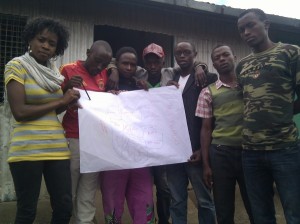
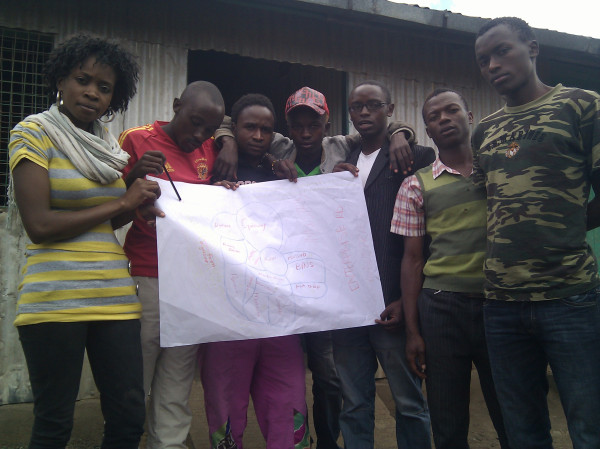
Mildred and Mukuru residents with hand-drawn village boundraies (photo credit: Primoz Kovacic)
Youth Fund grant was delayed until mid-2011. Some of the other initiatives the team was working on included the establishment of the local agency Map Kibera Trust, with support from the Africa Technology and Transparency Initiative and the expansion to work (led by Map Kibera Trust ) to Mathare and Kwale.
Map Kibera Trust received the Unhabitat youth fund grant in order to expand its work to other parts of Nairobi. Given the existing ties with Mukuru (an informal settlement in Nairobi’s industrial area) and the demand for training from young people who had been introduced to mapping in 2009 and 2010, the mappers decided to implement the youth fund grant in Mukuru.
The Unhabitat youth fund grant is designed to support organizations led by young people in developing countries. The grant involves a component of skills development; young people from selected organizations are trained in project management, documentation and budgeting. The young people then put their newly acquired skills into action throughout the project lifecycle.
Primoz and I have been supporting the mappers in Kibera, however we believe the best way to learn is through experience. And so in order to see them develop the new skills, we have taken a step back and supported the project mainly through some limited technical assistance. The field work and documentation has been led by Mildred Anekeya, the mapper coordinator (herself a young mapper from Kibera) and Vincent Mutuku and Moses Wahor, young mappers from Mukuru.
Below is a question and answer from Mildred, Vincent and Moses that documents their experiences in mapping Mukuru during the first half of the youth fund grant cycle. Their insights are important to those undertaking similar projects in similar contexts. These answers were submitted to Unhabaitat as part of a mid-term report.
What is the progress you have made [in mapping Mukuru]?
First of all we held two successful community forums, in Mukuru kwa Reuben and Mukuru Kayaba, which sensitized the community on the importance of mapping before we launched it. Finally we will hold other forums to confirm the mapping that we have done to the community.
We were been able to cover all five villages of Mukuru which are Mukuru kwa Njenga, Mukuru kwa Rueben, Mukuru Lungalunga, Sinai and Mukuru kayaba. We were able to train 24 trainees in data collection which involved usage of GPS gadgets, downloading the data, editing and uploading it which involved gaining of computer knowledge. We had problems like getting approval from the local authorities but we had to convince on what to implement on the ground and later they had to approve us. We also faced minor problems from the participants which are commitment towards the training and some were demanding allowance for their time, but after giving them the importance of the training they had to commit themselves fully. Insecurity was also one the problems but we had to find ways to curb it, and this was to work the residents from the same village.
What problems have you encountered during the first phase of the project?
At first we encountered problems from the administration, allowances of the trainees they were not ready to work without being paid, insecurity especially in Mukuru Kayaba and lack of commitment from the trainees especially Mukuru Kayaba where initially we had about 12 trainees and they all left remaining with 4. The obstacles that we faced in technical issues were: too few computers which led to extension of the timeframe and also it took time for the participants to catch up with what we were teaching them. Less internet modems which lead to limited internet access.
How did you overcome these problems?
Coordinators from Mukuru had to talk to the administration concerning the project and convince them for approval. They also coordinated and made the availability of the trainee to training centre. They ensured security was intact and organized for the venues. This made the mapping process run smoothly despite the challenges. Concerning technical issues we had to make use of what we had at hand and the administration of the Map Kibera Trust made sure that we full credits for the modems and the computers were available each time we needed them.
What project activities are planned for the next 6 months?
Drawing of boundaries of the villages and their zones, drawing of paths and tracks, drawing the industries and also showing how they are close to residential areas which can be used to explain some of the risks that people in slums are prawn to, like in the case of Sinai tragedy.
Finalizing on the mapping process and ensuring that the trainees are able to comprehend what we taught them.
Making follow up on all the stakeholders that would be interested in using the final maps in their work groups such as Administration, Youth, women groups, trainees, Community based and Faith based organizations.
To understand the spread of development in every particular village and also make conclusion on how the developments could be enhanced.
Any other comments?
The mapping exercise is a very unique method of bringing out problems in informal settlements; hence it should be enhanced to cover all the slums in Kenya. The trainees will need to have ongoing exercises less they forget what they learned, this can be improved by having substations in Mukuru.
by: jamie January 28th, 2012 comments:
Throughout October and November 2011, Plan Kwale worked through Map Kibera Trust with Primoz Kovacic and I, along with 4 young people from Kibera (Zack Wambua and Maureen Omino) and Mathare (Jeff Mohammed and Javin Ochieng), to conduct digital mapping exercises to support ongoing youth-led development processes in Kwale county. One of the important lessons learned through the Trust’s work in Kibera and Mathare is that the stories behind the mapping work are important for understanding the processes that contribute to a situation as represented on a map. To tell these stories and to complement the data collection and mapping work done by the youth in Kwale, the Map Kibera Trust team worked with the Kwale youth to set up platforms to share this information nationally and internationally. Sharing the important work being done in Kwale will hopefully bring greater visibility to the issues which may in the longer term lead to greater impact.
Sharing stories of local governance
To support their work on social accountability, the Kwale Youth and Governance Consortium mapped over 100 publicly and privately funded community-based projects. The projects were supported by the Constituency Development Fund (CDF), Local Area Development Fund (LATF), NGOs and private donors. As one channel of sharing this information, the Consortium set up a blog called Nuru ya Kwale (Light of Kwale). According to KYGC the blog “features and addresses issues concerning promotion of demystified participatory community involvement in the governance processes towards sustainable development. We therefore expect interactivity on issues accruing around social accountability.” This involves sharing evidence about various projects and stories from the community.
One example is the documentation of the Jorori Water project in Kwale; through the mapping work, the Governance team collected details of the constituency development fund (CDF) project. The funding allocated to upgrade the water supply for the community was 6,182,960 ksh (approximately 73,000.00 USD). From their research the KYGC identified that the Kenya Open Data site reported that the full funding amount has been spent. A field visit to the site however revealed that project was incomplete and the community is still without a stable water supply, despite the fact that the funding has been “spent.”

Read more about the questions the team raised in terms of the governance of CDF projects, including the detailed the project implementation process and some reflections on why the project stalled. This is information on community experiences (tacit information) that is well-known in a localized context but has not been documented and shared widely. New media tools, a blog in this case, provide free (if you have access to a computer and the internet) platforms for sharing this information with national and international audiences.
Addressing violence against children and child protection
Another blog was set up by the Kwale Young Journalists. The Young Journalists, registered in 2009, have been working with Plan Kwale on various projects, including Violence against Children campaigns. The group has been working to set up a community radio station in Kwale to report on children’s issues. Thus far, their application for a community radio frequency has encountered several challenges – new media provides an interim solution and will allow the team to share their stories and network with partners on a national and internal stage.
The Kwale Young Journalists worked with Jeff Mohammed, a young award-winning filmmaker from Mathare Valley. The YETAM project not only equips young people with skills, but through peer-learn establishes connections between young people working on community issues throughout Kenya. The programme also provides young people with life skills through experiential learning – Jeff reflects on his experience in Kwale and says:
“My knowledge didn’t come from books and lecturers it came from interest, determination and persistence to know about filmmaking and this is what I was seeing in these Kwale youths. They numbered 12 and they were me. They are all in their twenties and all looking very energetic, they had the same spirit as mine and it was like looking at a mirror. I had to do the best I could to make sure that they grasp whatever I taught.”

Jeff worked with the Young Journalists on a short film called “the Enemy Within.” The film, shot with flip-cameras, tells the story of 12-year-old girl who is sold into indentured labour by her parents to earn money for her family. During the time she spends working, the young girl “falls prey of her employer (Mr.Mtie) who impregnates her when she is only 12 years old.” Jeff reflects that “early pregnancies are a norm in the rural Kwale area and what the young filmmakers wanted to do is to raise awareness to the people that its morally unacceptable to impregnate a very young girl, in Enemy Within the case didn’t go as far because the village chairman was bribed into silence and didn’t report the matter to higher authorities.” This is a common scenario in Kwale, and the young journalists plan to use the film in public screenings and debates as part of their advocacy work in the coming months.
Jeff and the Kwale Young Journalists shot the film in four days – they travelled to Penzamwenye, Kikoneni and also to Shimba Hills national park to shoot 7 scenes for the movie. Read more about Jeff’s reflections on working with the Kwale Young Journalists on his blog.
Sharing ecotourism resources
The Dzilaz ecotourism team – a group that encourages eco-cultural tourism in Samburu region of Kwale count – also integrated social media into their work. During the last week (November 8th-12th) the group set up a blog to market the community resources, services and products. They also plan to document eco-culture sites and the impact that eco-tourism can have on the community. As of November 10th, 2011 the Dzilaz team had already directed potential clients to their website and thus secured a booking through the information they had posted.
The importance of telling the stories behind the maps
One important component to mapping work is to tell the stories behind the map. The three groups in Kwale are working to build platforms to amplify their grassroots level work in order to share stories and lessons learned; the information documented on the various platforms will hopefully develop over time and contribute to a greater understanding of the processes at a local level – and where youth as young leaders can intervene to begin to change the dynamics of community development.
–
Cross posted on Linda Raftree’s blog Wait…What? and my health geography blog.
by: jamie January 13th, 2012 comments:
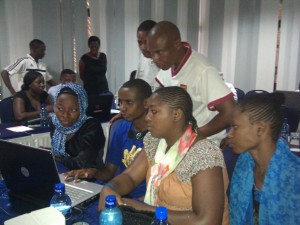
The Map Kibera team had a busy end to 2011. From August to the end of December 2011, we have been involved in projects in Kibera, Mukuru (Nairobi), Kwale (Coast) and Dar es Salaam (Tanzania). Mappers from Kibera have travelling across the city, country and even regionally to share their skills with other young people in East Africa. They trained approximately 40 young people in Mukuru, 30 in Kwale and students from Ardhi University in Dar es Salaam. This networking and sharing is beginning to create an informal network of young people, with skills, experience and passion for mapping for change. Although they are not always working in Kibera, the exposure the mappers get also helps to continue to “put Kibera on the map.”
Work on the atlases and wall painting for Kibera is also ongoing. The final edits are underway and 2012 will be busy for the team – producing an atlas distribution strategy, contacting partners for atlas request, visiting schools and health clinics and painting walls! Of course, the team will also gather feedback and document the process to being to better understand how community information can lead to change.
As we move into 2012, the Map Kibera team wishes you a wonderful start to the new year!
by: jamie September 15th, 2011 comments:

Training youth mappers in Mukuru
It’s not if but when, And the when took place this Monday morning. A KPC pipeline – that runs through Nairobi’s informal settlement of Mukuru – exploded, taking with it the lives of 95+ people who live, work, school and play near in one of the marginal areas of the sprawling metropolis of Nairobi city.
Kenyans have been discussing the pipeline disaster and have been analyzing the factors that led up to the event. On Tuesday, both the Standard and the Daily Nation ran 11 pages of coverage of the event. It’s not surprising that journalists have in the past covered the precarious situation residents of the Sinai village face. There is often coverage of other dangerous conditions Nairobi residents live in – such as those living along the railway or high voltage power line in Kibera, or the polluted river in Mathare, or the dumping site in Dandora.
Many are not aware that the Sinai village (referred to in the media as Sinai slum or Lunga Lunga slum) is one village in the larger informal settlement of Mukuru. Mukuru is located in Nairobi’s industrial area. Access to the area is facilitated by roads that lead along the backs of factories and warehouses and industrial workvsites. The dangers of living in Mukuru slum are apparent as factories bellow out smoke, trucks carrying hazardous materials rumble by and pipes and electrical towers dot the landscape.
For the past 2 months, the Map Kibera Trust team have been working with youth in Mukuru. The “Map Mukuru” project began with funding from Unhabitat’s Youth Fund and interest from young people in Mukuru who we had worked with in 2010, with funding from HIV Free Generation.
The Map Kibera team has been engaged is a long-term process of skills building for young people in Nairobi’s informal settlements of Kibera, Mathare and now Mukuru. The Mukuru project is being run almost entirely by young mappers from Kibera – we’ve taken the opportunity of receiving the youth fund grant to push the Kibera youth to manage the project on their own and to exchange skills and learn from other young people.

Maureen Omino from Kibera trains mappers in Mukuru
The team is saddened by the tragic event in Sinai. The event hit some of our mappers quite hard – they were in the field in the area of the blast the previous week and were thankful that we were inside, editing data at the time of the explosion. None of the mappers were injured during the explosion but some lost friends in the fire and we send our condolences to the families and friends of the victims.
Our mapping work however is not a reaction to any singular event – it is a long-term effort aimed at amplifying the voices of residents of informal settlements. Our mission is to increase their representation and influence in decision making processes. By training young people as mappers and digital storytellers, we hope we are contributing to community resilience, not just to respond to disasters like the Sinai fire tragedy, but to ultimately reduce the risk to resident in informal settlements through identifying solutions to ongoing problems and dangers in the local environment.
by: jamie August 23rd, 2011 comments:
On August 16th, Map Kibera Trust posted about the bonus day on Global Giving’s August Open Challenge. We are pleased to announce that in 1 day we raised $990 from 18 donors, and received $82 in matched funding from Global Giving! Thanks to all of you who donated on that day, and throughout the challenge. We are honoured to have your support!
NOW we have 8 days left to raise $1,485 to complete our fundraising goal of $4,000. To date we have raised $2,515 towards our goal (with a bonus of $82 from the bonus day fundraising efforts).
Please share this widely – Map Kibera needs your support to Turn Maps into Action in Kibera!

Zack Wambua maps the railway line in Kibera
by: jamie August 16th, 2011 comments:
Map Kibera Trust put Kibera on the world map! Our team of community mappers plan to bring the map information to local change agents in the community, through printed atlases and map murals throughout Kibera.
To support our work, we are currently participating in the Global Giving August Open Challenge. During the challenge, we have 4 weeks (August 2nd – August 30th) to raise $4,000 from 50 unique donors. To date, Map Kibera has raised $1,685 from 24 amazing supporters. Get involved and help us meet our goal so that we can print maps and paint wall “map murals” to share information in Kibera.
Follow this link to give today! (P.S. Today (August 16th) is Bonus day on the challenge each donation will be matched by an extra 15% by Global Giving!).
Read on below to hear about our project.

What is the issue, problem, or challenge?
Kibera, in Nairobi, Kenya, is a slum housing some 250,000 people. Kibera is likely the most photographed, researched, and well-known slum in the world. Before October 2009 however, Kibera did not appear on the world map. Map Kibera trained thirteen youth from the slum to use GPS devices to map points of interest in their community, such as clinics, water sources, landmarks, toilets, street lights, and businesses. The youth will now reach out the the community and 200 change agents with the maps.
How will this project solve this problem?
The Map Kibera team wants to make sure that the local community is part of discussions about the challenges facing slum residents around the word. This project will reach out to local change agents to distribute the maps and discuss how geographic information and open data can be used to improve project delivery and development in Kibera and other slums around the world.
Potential Long Term Impact
We will reach out to 200 change agents around Kibera to discuss how community generated information can improve the delivery of services and the implementation of projects in Kibera.
Project Message
“The training and the whole process of mapping has changed me…I feel much more confident and well informed…I will not leave Kibera but will stay and make it a better place to live.”
- Regynnah Awino, Kibera mapper
Update: it’s 50 unique donors, rather than 40. Thanks!
by: jamie August 1st, 2011 comments:
You may have seen a lot of action from @PrimozKovacic today on Twitter. That’s because Map Kibera is set to facilitate Map Mukuru!
In 2010, Map Kibera worked with HIV Free Generation and Emory University to offer training in GPS data collection and OpenStreetMap (OSM) tools to youth engaged in health asset mapping. In previous years, the HIV Free Generation and Emory team had worked with a large mapping firm to produce maps of health assets in the area. The team soon realized that capacity for data collection and mapping of the area needed to be built locally – enter Map Kibera.
Our team facilitated a brief 3 day training and followed up with some data collection and OSM support in the following weeks. During that time, we were impressed by the enthusiasm and skills of the youth in Mukuru (view their work in OSM here).
In late 2010, when the Map Kibera mappers were awarded a UNHABITAT Youth Fund grant we immediately thought of Mukuru. We had kept in touch with Vincent Mutuku and Moses Wahor, two of the star mappers from Mukuru. They had been asking when we could come back to Mukuru. We reached out to them again and they were excited to continue mapping their community.
Mukuru is made up of 3 distinct areas – Mukuru kwa Ruben, Mukuru kwa Njenga and Kayaba. The 2010 mapping only focused on Mukuru kwa Njenga and the health assets in that area. Our challenge for the coming months is to map the entire 3 areas based on community priorities.
The first planning meeting for Map Mukuru was held on 29th June 2011 at Map Kibera office. The meeting was attended by Vincent and Moses (the two Mukuru coordinators), Kibera Mappers and Map Kibera management.
During the meeting, the team discussed the steps in the mapping process. Based on our experience in Kibera and Mathare, we identified the following questions and ideas:
- What are we going to do?
- We should involve community leaders who know the location
- We need to have community meetings to identify their views and priorities
- We need equipment and supplies eg GPS, computers, stationary.
- We need a base of operation (or 2-3 bases because of the size of Mukuru)
- Identify the number of mappers in Mukuru (again, based on the size of the area)
- Number of local coordinators – we have 2 so far!
- Decide on a Time frame – (which is 5 months as outlined in the Youth Fund proposal)
- Be sure to gather feedback from the community after the first mapping
- We need to print maps and distribute them to the community (Hard copies)
We agreed that the Kibera mappers will provide overall leadership, experience and training, but the people of Mukuru people will map their own villages.
Between June 29th and August 1st, Vincent and Moses identified two operational bases in Mukuru (at Goal Kenya and St. Mary’s Church). They also set about mobilizing important stakeholders, including the local administration in the area (District Commissioners, District Officers, Chiefs). They also approached over 100 youth groups, NGOs and women’s groups in the areas to determine their interest in the mapping project. All the community mobilization efforts paid off and the 1st community forum today attracted 150 guests! We’ll be holding a second forum on Friday.
Keep your eyes on the blog for further updates.
by: jamie July 4th, 2011 comments:
Map Kibera Trust recently facilitated a 3 day training to introduce participatory digital mapping to target staff at Plan Kenya. The participants in the workshop included programme staff and ICT staff from the Kenya Country office and regional offices around the country. Participants came from Homabay, Kisumu, Kilifi, Kwale, Tharaka, Machachos, Bondo, the Kenya Country Office and the Urban Programme (Nairobi). Their backgrounds ranged from ICT support staff, to Child Rights & Gender Advisor, to M&E Coordinator, to programme staff in 4 of Plan’s 5 focus areas (Protection and Inclusion, Health, Education and Governance).
The training was planned at the beginning of the implementation of the new Kenya country strategic plan (CSP) 2011-2015 for Plan Kenya. Building on the success of Plan Kenya’s work in Kwale on universal birth registration and also from digital mapping work with POIMapper and Map Kibera Trust, the new CSP highlights the importance of ICT in the improved efficacy of Plan’s work. Plan Kenya has chosen to place an explicit focus on participatory ICT in its work. This is in line with Plan International’s focus and leadership in ICT4D globally.
In this context, the workshop aimed to:
- Introduce participatory digital mapping theories, techniques and tools that Map Kibera Trust employs in its work
- Provide hands on experience in GPS data collection and data editing using Open Street Map
- Learn more about how Plan Kenya programmes use information and communicate
- Brainstorm ideas about how to integrate ICT into programme work
We began with an introduction to Information Communication Technology for Development (ICT4D) by exploring some questions to consider before introducing ICT into programme work. The questions were (and are) meant to stimulate discussion and encourage participants to think systematically about the integration of ICT into new and existing programmes. The questions identify the reasons why you would use ICT, assess what constraints and opportunities exist in the framework you are working in, and explore how people are communicating in order to design appropriate and sustainable systems to build upon existing channels of communication. The questions are modified from Linda Raftree’s post “7 or more questions to ask before adding ICTs,” so thanks to Linda for the inspiration!
1. Why are you considering the use of ICT?
The Plan Kenya staff identified that using ICT, particularly mobile phones and the internet, has become a desired lifestyle choice that the majority of Kenyans around the country have embraced. This was an important point that the participants wished to build upon and capture in their use of ICT in various communities. The group generally agreed that ICTs are available and can be accessed by many Kenyans. The staff also mentioned that ICTs could improve communication and be used to easily mobilize communities (for example sending one SMS to many people to attend a meeting). ICTs are flexible and can improve accuracy and consistency in information, which can then be easily stored and shared. There was also mention of improved efficiency in programme work through the collection and processing of real-time information.
2. What are the programme goals or programme framework you are working within?
Most of the participants identified the new country strategic plan for the organization as the overarching framework that Plan Kenya staff are working with. The country strategic plan identifies 5 areas of focus: Health, Livelihoods, Education, Protection & Inclusion and Governance.
3. What are your specific information and communication needs?
The information needs of Plan Kenya staff members were largely related to programme work. The needs included collecting accurate data for baseline surveys for Monitoring and Evaluation and thus to assess programme impact. There were some suggestions of improving communication through digitizing information that can more easily be shared to large numbers of people. The group suggested that this could improve accountability to other staff members, donors and to beneficiaries in communities. ICT can also improve the ability of Plan Kenya staff to analyze information and make decisions.
4. How are you already using information and communicating?
In order to integrate ICT into existing programmes within communities, it is important to know how staff members are already using information and communicating in their daily lives. The group came up with a long list of communication tools: email, internet, intranet, websites and social netoworks – namely Twitter, Facebook, Flickr, MySpace), applications (Skype, Yahoo Messenger), SMS and telephone calls, radio, and television. The group is using information during baseline data collection. Some are involved in a project that integrates SMS applications into the birth registration process in Kwale District.
5. Who are the actors involved in the particular issue you are seeking to address with ICT?
The Plan Kenya staff won’t be (and aren’t) using ICT in isolation. There are important stakeholders they work with on particular issues, programmes and projects. These include the general community – with a particular focus on youth and children. Important sub-sections of the community include teachers, school administration, Government of Kenya, civil society organizations, Plan Kenya partners (such as Childline Kenya, Community Cleaning Services), the media and private sector actors. Different groups of people use technology differently, and depending on the answer to question 1) and question 6 (below) the staff may need an ICT strategy that is diverse enough to reach the various stakeholders.
6. How do people use ICT already?
This list of the ways in which Kenyans are already using ICT is a testament to the idea that the group tapped into when answering question 1. The use of ICT in Kenya, specifically mobile phone applications, has become a lifestyle choice. Kenyans use phones for mobile money transfer, SMS, calling, accessing the internet, paying their bills, paying for goods, calling toll-free lines (e.g. Childline call centre, police hot lines) and for data collection and dissemination. Kenyans also listen to the radio, use computers, blog, email, chat, shop online, bank online, join online discussions and news groups and use various forms of social media. They do this for work, but also for pleasure. These were the means identified by the group, however this is not an exhaustive list.
7. How do people access technology already?
This was a sub-section of question 6 and the group answered: mobile phones (including GPS enabled and internet enabled phones), street phones, computer, internet connection in office and homes, internet modems, cyber cafés, radios, TVs, toll free lines, and resource centres.
8. How will you close the feedback loop and manage expectations?
How do you make sure the information you are generating, no matter the medium or tool you are using, gets back to the community? How do you promote the use of technology without seemingly presenting a silver bullet solution (even if you don’t intend to do so)?
These questions were answered in several ways. One idea about both closing the feedback loop and managing expectation was to network with other organizations and partners in the community to share information and raise awareness about the use of ICT and the opportunities and limitations of ICT4D projects.
Another option for closing the feedback loop was to both collect and disseminate information on popular social media sites such as Facebook and Twitter.
A third suggestion was to close the feedback loop and manage expectations through an informed resource person and/or resource centers and staff having sessions with the community.
Finally, there was the suggestion to start the integration of ICT in development work by outlining and communicating clear expectations and at the end have feedback sessions to monitor the whole process.
9. What is your sustainability plan?
The final question, and likely the most difficult (we only had a one hour brainstorming session and did not expect participants to come up with final answers to this question but simply consider it as an important component to any project with an ICT component).
One idea was to equip community members, and particularly youth, with skills that will be applicable beyond the program (or project) timeline. The YETAM project (youth empowerment thorough arts and media) was designed in this way and the group agreed that this design was beneficial to the young people involved in the program.
Another suggestion was to involve the beneficiaries/community in the entire process of choosing/customizing appropriate ICT tools that suit their needs and for further development so that it is community owned process and will in theory continue beyond the project/program lifecycle. Other ideas included:
- Build partnership with Government and NGOs.
- Integrate fund raising or income generating activities into the project.
- Use affordable technology (free and open source)
- Ensure follow-up mechanisms are built into the project
We discussed the use of mapping, open information and ICTs for development. We also used two of the three training days to focus on hands-on training and skills building. We facilitated training in handling the GPS devices, collecting data and using Java Open Street Map (JOSM) and Potlatch to record open spatial information into the OpenStreetMap databases. As we’ve found in the past, the hands on training is exciting and motivating. The theorietical discussions, combined with the practical field work inspired discussion and debate on ideas on how to integrate participatory digital mapping andICTs into programme work.
The following are ideas generated by the Plan Kenya staff:
- Ushahidi could be useful for referral partners mapping and identifying the hot spots of child abuse
- Use of SMS for communication with hearing and speech impaired within the community
- Using reports and sharing the same information to various media channels. E.g. PPM a in-house system that is used to track and monitor information and projects progress
- In governance as a tool for enhancing social accountability, where ICT can be used to track projects
- Digitization of data collection e.g. in sponsorship (especially photography), child abuse hotspots
- Involving children in participatory community mapping by mapping schools using walking papers
- Using blogging as a tool for youth to document governance issues in the new good governance project for the Urban Programme
- In Kilifi the team is doing a 2 year study on Open Defecation Free villages and health outcomes. They could use mapping and spatial statistics to document findings.
- Mapping and other ICT4D tools could be used to document and share participatory activities that Plan already undertakes, such as transect walks and participatory situational analyses
The training ended with a note of caution – the team recognized the potential tension between the processes that are needed for ownership of a community map (and any other ICT4D project) and the haste of development partners to use the budget and report progress to donors. In this case, many projects (ICT4D, mapping and any other project) may “leave the community behind.”
It is thus important to ask the following questions and consider the answers carefully when designing projects:
- For whom are we doing the mapping (or any project really)? And whose map is it?
- Of what use is the (spatial) information, what will it compliment?
After another successful workshop with Plan Kenya, we look forward to building on the excitement and enthusiasm generated during the training! Let’s see some of the great ideas turned into reality!
Cross posted on my blog.
by: jamie May 2nd, 2011 comments:
Digital storytelling and new media can be a powerful catalysts for change. In areas where access to internet is limited for most people, introducing new media as an effective means to communicate issues can be a challenge.
Young people in Mathare own mobile phones and have a facebook and email accounts, however the majority of Mathare residents do not use new media or online means to share information. As highlighted in this video Information Sharing by young Mathare residents, word of mouth is still the most powerful medium for information sharing in Mathare.
“Tell me a story, and I will tell you mine. Word of mouth has so much power to make and build a nation”
The team acknowledged these challenges but thought it worth while to experiment with new media in Mathare, as had been done in Kibera. The new media training programme in Mathare was built based on the experience of the Map Kibera team in designing and developing a web-based information sharing site. The information sharing site for Kibera utilizes the Ushahidi platform for ‘crowdsourcing’ information. In this instance, crowdsourcing refers to providing a channel for information from the general public to be published openly on the internet. The site, Voice of Kibera, aggregates information channeled through short messaging system (SMS) messages and web based submissions and displays report on events, activities, news and other information about Kibera. The site also aggregates content from other sources on the web, including video and news reports. Despite the challenge of internet access, the team behind Voice of Kibera believes the site is an important channel for highlighting issues from Kibera. The team is actively engaged in improving the impact of the site and are excited about its growth.
A similar site initially called “Voice of Mathare” was set up for the Mathare programme. The site was meant to be a means through which Mathare residents participating in the training could highlight issues and information generated by the people of Mathare. While the technical issues were being sorted out for the Voice of Mathare site, the Mathare project coordinator and some of the participants from the other programmes took an interest blogging that was being done by others in the Map Mathare organizing team.
Through a number of discussions, the Mathare participants decided to set up a blog of their own. The Mathare Valley Blog was a thus a spin-off of the Map Mathare work.
The Mathare Valley Blog has become a central site where stories, news and videos generated by the Mathare participants are collected and shared. The blogging team meets of their own initiative and has kept up the momentum for the blog. They actively brainstorm ideas and making changes to the layout and format of the blog. The Map Mathare team provides some technical support to the bloggers and the site continues to run as an effective digital storytelling platform.
Currently the Mathare Valley Blog has 61 blog posts contributed by six different bloggers from Mathare . Five of the six bloggers are under the age of 25 and have written a blog post for the first time on the Mathare Valley Blog.
Over the past four months (January – April) the blog has been viewed 4,466 times and has six subscribers, plus many other online followers. One Plan USA staff member who runs a blog on ICT and development picked up activity on the Mathare Valley blog and wrote her own post “Mathare Valley is blogging.”
Success stories
The blog has attracted considerable attention within and outside Nairobi and Kenya. There have been numerous success stories that have resulted from the blog. The first is a result of this story, entitled “Attempted rape by a neighbor”. Simon, the author, followed up on the blog post and wrote about the girl’s attempt to contact the authorities in this post. After reading these two posts, a human rights activist from Nairobi contacted Simon and was put in touch with the young girl from the story. The activist then accompanied the girl to the police station to follow up on her case and assure a report was properly filed and acted upon.
The second success story was sparked by this blog post about Mr. Ndeti from Mathare who speaks fluent German and has started teaching German to interested students. The blog post was forwarded to the Goethe Institute in Nairobi. A staff member from the Goethe institute read the story, took an interest in Mr. Ndeti’s work and was put in touch with the teacher. Through this interaction, the Institute donated books and material to support the initiative started by Mr. Ndeti in Mathare.
One of the young bloggers (and videographers) has attracted the attention of an international newspaper published by the Rebel Film Board. The newspaper was impressed by his writing and has offered to publish a version of his post on “The Vice of Violence in Mathare” in their publication, which circulates in print in Toronto and Mathare.
In a short time, the blog has proven an extremely effective platform for young residents from Mathare to highlight their stories. The blog facilitates online – and more importantly – offline dialogue and action on issues of importance to the residence of Mathare. The Mathare Valley Blog is most importantly an initiative of Mathare residents themselves.
To provide the participants with some ideas about other options in terms of new media, some basic training on the use of the Ushahidi Voice of Mathare platform was provided to some of the Map Mathare project participants. The Voice of Kibera team conducted a number of hands-on trainings with 8-10 Mathare participants. The participants were interested in the platform and learning from the experience of the Voice of Kibera members, but did not take-up the software as we saw in Kibera. We therefore agreed to provide technical support for the blogging platform as a central online information focal point for the Map Mathare initiative. We were careful not to impose the original ideas of New Media in Mathare and have adhered to the original methodology agreed upon by the team with support from Plan Kenya and CCS. This was a community driven approach from which the technical and coordination team “leads from behind”. We are and continue to be flexible when it comes to programming in Mathare.
by: jamie March 30th, 2011 comments:
The question that sparked this post is: whose mandate is it to collect information?
A few weeks back our team attended a meeting with Plan Kenya and partners who are using mapping tools for generating information. Someone in the room asked:
“Whose mandate is it to collect information?”
The meeting was called to discuss a specific tool data collection tool called POImapper, which is being developed by a Finnish company called Pajat. Plan Kenya is piloting the tool and has developed custom data collection forms to collect data to inform Plan’s work in Kilifi. There is no question about mandate when gathering programmtic level data (about children benefiting from Plan’s sponsorship programme for example). The concern raised during the meeting was about an organization collecting public information in an area where government should be providing this information – this includes the base level information on roads, schools, and other public infrastructure.
One of the major challenges of using POImapper however is the lack of base maps upon which to overlay the Points of Interest (POI). Without good base layer data, it is difficult to discuss the implications of the information being collected. Pajat and Plan Kenya made the decision to switch from Google Maps to OpenStreetMap because of this challenge (through our work with Plan Kenya, we also hope we played a part in this decision). With OpenStreetMap, the organizations are free to improve the base layer information as necessary and use the data in their (for-profit) portal. But this brings up the question of mandate? Should a non-governmental organization (NGO) really be doing this work?
The question about mandate got me thinking about how government, citizens and organizations collect and share (or don’t share) information.
The question “whose mandate” gets at the question “whose information is this that we are collecting?”
One point of view (shared by some at the meeting) is that information is the property of the government. The government is mandated to collect and disseminate information for the public good. Others should not interfere. There is validity in this point of view.
Access to information is in the Bill of Rights of the newly adopted Kenyan constitution. “Right and fundamental freedom” number 35 in Chapter Four, Part 2 states that:
35. (1) Every citizen has the right of access to—
(a) information held by the State; and
(b) information held by another person and required for the exercise or protection of any right or fundamental freedom.
(2) Every person has the right to the correction or deletion of untrue or misleading information that affects the person.
(3) The State shall publish and publicise any important information affecting the nation.
The government is constitutionally mandated to grant any citizen access to “information held by the State.” The government is mandated to go even further and not only publish “important information affecting the nation” but must also publicise this information (theoretically improving accessibility).
But the reality of the situation is the governments don’t always do what they are mandated to do. Sometimes governments need a push in the right direction – a reminder of their role and their responsibility to the citizens of their country. The government may also need a “proof of concept” – a demonstration that there is an easier, more cost effective and efficient way of delivering information and services to citizens.
One example would of a “proof of concept” is the use of ICT in universal birth registration in Kenya, being piloted by Plan Kenya in Kwale.
On the Plan Kenya country website for this campaign it states
“It is government policy that every child should be registered at birth, and this is covered by the Births and Deaths Registration Act. However, there is a huge gap between law and practice. Birth registration is not fully decentralised, and so families have to travel long distances, particularly in rural areas, to access registration services. The birth notification process – through which parents complete a notification form at the chief’s office when a child is born, which are then submitted to the district registrar of births – can take more than a year or even two. Any registration after six months of birth is considered late registration, when the process is more complex and lengthy, and there is also a penalty – which act as deterrents to the registration of children. Parents also do not see the need to register their children and so do not actively seek out registration services. The government is reviewing this Act, which we hope will ensure greater access to registration services for Kenyans.”
Instead of waiting for the government to improve its birth registration system, Plan Kenya is working together with local government to digitize the birth registration system.
This is a success story of a local government partnering with an NGO to achieve results. It is also why we have advocates – advocates for access to essential medicines, for improved service provision, for freedom of the press, and the list goes on.
In this case of improving access to information generally, we need information advocates – those citizens and/or organizations who advise individuals and organizations on the importance of information, where it can be accessed and how it can be utilized. Information advocacy is similar to info-activism, but does not specifically target activists or advocates. Information advocates raise awareness about the importance of information more generally.
Should international, national or local NGOs information replace the need for government information? No, indeed NGOs should not. Organizations and advocates should work closely with government to advise and improve systems for collecting and disseminating information. It is government policy, in many countries to provide access to information. Governments and NGOs need to work together to open up information and make it accessible for local populations
I must admit that the Map Kibera team is biased toward open knowledge and/or open data. We have a commitment to open data. We create, share, and advocate for open information, in all sectors (NGO, government, citizen). The disclaimer is of course that not all data should be made public – for example private data that may endanger individuals or invade privacy should not be made public (such as precise locations of individual vulnerable children or families, individual level health information, etc). Aggregate information of this kind may however be useful for planning and advocacy purposes.
We do focus on public information – that is information about services that are open and available to the public – such as water access points, sanitation facilities (toilets mainly), schools, health clinics, shops, kiosks, restaurants, bars, and many more. The teams in Kibera and in Mathare are working hard to integrate information into local government channels.
Demand for open government data is increasing around the world. Kenya is not unique in terms of challenges in opening up government data. In Kenya there is however very little data available at the local level. Through visits to City Council and local authorities in Kibera and Mathare, we’ve learned that the local area counselors, chiefs, District Officers, District Commissioners, and other officials do not have access to maps of their areas. The local government authorities may need some support in terms of generating baseline information (including maps) of their constituencies. This is not a criticism of the government, but a call for NGOs, citizens and government to work together to generate and share information for better planning and development. This is a major challenge, but our teams are consciously working hard to open dialogue with local government to create sustainable systems of information creation and dissemination. Plan Kenya has been an invaluable partner in terms of advising and supporting this process. Keep your eyes out for updates on the work in Kibera and Mathare.
[Cross posted on my blog]